


For decades, the flooring aisle has offered a familiar tradeoff. Natural wood brings warmth and longevity but at rising cost and environmental strain. Vinyl promises affordability and convenience, yet increasingly raises questions about what it introduces into the home. As homeowners, schools, and designers reconsider those choices, hemp is beginning to surface as a credible alternative.
Hemp-based flooring sits at an unusual intersection. It is neither synthetic nor traditionally timber. Instead, it relies on the fibrous stalk of Cannabis sativa, a plant historically grown for rope and textiles, now reimagined for the built environment.
Greg Wilson, founder and co-owner of HempWood, came to hemp through a different “alternative” material first: bamboo.
From Bamboo Lessons to Hemp Solutions

Wilson spent over ten years building bamboo flooring factories in China, learning how to industrialize plant fiber into something consistent, scalable, and sellable. That experience also exposed him to one of the industry’s persistent liabilities: chemical-heavy inputs used to make engineered products behave like wood.
“I got really sick from the bamboo process using formaldehyde,” he said.
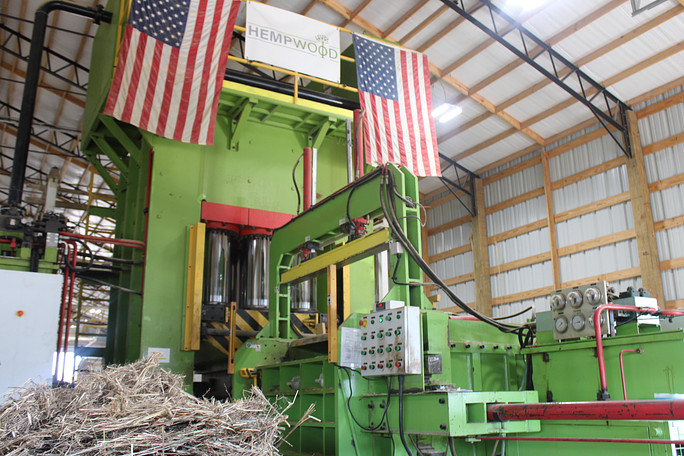
When hemp cultivation reopened under federal law, Wilson revisited earlier research and patented a method for turning hemp stalks into dense, wood-like boards. It was not, in his telling, an ideological pivot, but rather an engineering evolution rooted in a desire to avoid the toxic binders that still haunt parts of the imported flooring supply chain.
Hardness, Wear, and the Commercial Test
Compressed hemp fiber reinforced with soy-based adhesive produces a board that Wilson says can outperform many traditional hardwoods.
“Hemp wood is 20% harder than hickory, which means 40% harder than oak,” he said, describing why the product has found traction in commercial environments where durability matters more than aesthetics alone.
That claim lands in a practical place for buyers. Hardness translates to fewer dents, longer service life, and better performance under foot traffic, the everyday realities that make wood worth the investment in the first place.
Why Vinyl Keeps Coming Up


If hemp is competing with hardwood on durability, it is competing with vinyl on a different axis including what’s in the material and what it can release into the air over time. Vinyl’s value proposition is clear. It is affordable, easy to install, and often designed to convincingly mimic natural grain. But it is also petrochemical by design, and its chemistry has a long, uneasy history.
“PVC flooring is literally made of something that was deemed to be a cancer causing chemical in 1978 by EPA,” Wilson said, referencing vinyl chloride’s classification and using it to argue that indoor air quality should be part of any renovation calculus, especially in schools and public buildings.
Wilson has leaned into that health framing as consumer priorities shift. “The healthy element. Everybody has to deal with that,” he said.
The Awareness Gap
Even with performance and health arguments, hemp flooring still faces the challenge of visibility. Most people do not know it exists. Wilson estimates fewer than 5% of Americans have heard of HempWood, a number that likely reflects the broader category’s obscurity, not just one brand’s marketing reach.
His ultimate goal is to normalize hemp as a choice. “I want people to just say, you can use wood, you can use vinyl, you can use bamboo, you can use cork, you can use hemp,” he said. “That’s the space we sit.”
Hemp flooring is unlikely to replace hardwood’s prestige or vinyl’s price advantage overnight. Its significance is quieter and potentially more durable. It expands the menu at a moment when materials are increasingly judged by what they mean for the air people breathe and the spaces they occupy every day.