


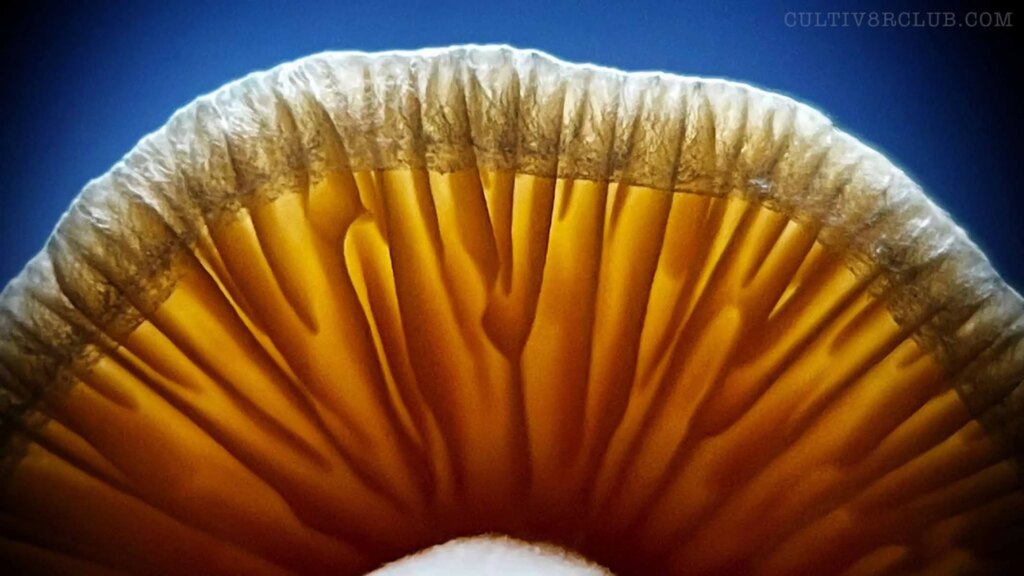
If you’ve taken magic mushrooms, it’s most likely you’ve consumed the UK’s native wild-growing Liberty Caps, aka Psilocybe semilanceata, or one of the commonly cultivated Psilocybe cubensis strains such as Golden Teachers.
Amongst mushroom growers and psilonaut circles, another species of psychedelic mushroom is having a moment in the spotlight. Psilocybe ochraceocentrata is making waves amongst those in the know… and for good reason. Native to Zimbabwe and South Africa, and found growing on or near decomposing native mammalian herbivore dung, the species favours mixed deciduous and miombo woodland on granitic sand. The species name “ochraceocentrata” refers to a key visual characteristic of this species: the prominent ochre-yellow colour spot at the centre of the cap. Genetic sequencing has revealed it to be a closely related sister species to the more familiar Psilocybe cubensis, which it closely resembles in appearance. But it is the tenacity and effects of this species that have mushroom aficionados excited.
A tangled taxonomic backstory
Until quite recently, P. ochraceocentrata was mistakenly lumped together with the species P. natalensis, which it was referred to as, sowing spores of confusion throughout the cultivator community. The species P. natalensis was formally described in 1995, with mushrooms collected from high-elevation grassland in the KwaZulu-Natal region of South Africa. The genetics of what was considered to be P. natalensis have been doing the rounds in cultivator circles over the last few years.
However, no samples of P. natalensis or those labelled as ‘Natal Super Strength’ (considered a South African variety of P. cubensis) by spore vendors submitted by members of the cultivator community for genetic testing matched the sequence of the type specimen of P. natalensis. Instead, these samples genetically clustered with P. ochraceocentrata (or what had been previously temporarily described as “P. aff. natalensis”; the ‘aff’ referring to its affinity to P. natalensis). P. ochraceocentrata was revealed to be its own distinct species, and the closest living relative of the more familiar P. cubensis, with both likely sharing a common ancestor around 1.5 million years ago. Genetics of the ‘real’ P. natalensis have now started to trickle into cultivator circles, with some initial analyses suggesting it is a species of low potency, with a much longer growing time than P. ochraceocentrata or P. cubensis.
Traditional Usage of Psilocybe ochraceocentrata
It has recently been discovered that P. ochraceocentrata mushrooms are used traditionally by healers among communities of the Xhosa in South Africa (the second largest ethnic group in the country). This mushroom – which is referred to as ‘Inkokowane’ – is used in a variety of ways by the Xhosa in the Eastern Cape province. When interviewed by South African ethnomycologist Cullen Taylor Clark, one healer stated that they have been using this mushroom to do their work and provide them with insight as far back as they can remember.
The mushroom is used as both a tonic and a ceremonial sacrament. It is used as a tonic in small doses with various herbs, roots and barks to treat a range of maladies, to help fortify vitality and strength, and to promote healing. It is also used in larger quantities in a community-centred ceremonial context by igqirha (diviners or shamans) to act as a conduit to their ancestors, through which insight and guidance can be obtained. Community members partaking in the ceremony assist in preparing the ceremonial space (one of the healer’s homes) and in acquiring the necessary materials. The mushrooms were added to water in a cauldron and brewed up as a decoction, chanted over and inspected until deemed ready for consumption. The ceremony involves various ritualistic elements, such as the burning of herbs, the lighting of candles, fungal face painting, drumming, dancing, singing, storytelling, and intervals of silent reflection.


A boon for beginner growers
Like P. cubensis, P. ochraceocentrata is an easily grown species that grows quickly, producing bountiful yields of mushrooms, and can be cultivated in the same way using the same techniques and substrates.
One major bonus of growing P. ochraceocentrata is that it is known to have particularly aggressive and contamination-resistant mycelium, and more so than P. cubensis. While P. cubensis is a tenacious and forgiving species, moulds can rapidly spell doom to a fruiting flush of the fungus. A more resilient and contamination-resistant species, such as P. ochraceocentrata could be a boon for beginner cultivators, among whom contamination is the number one cause of cultivation failures.


It also appears to be tolerant of low temperatures, colonising substrate and fruiting at 62° F/16.6° C, although growing times will be significantly extended. While a great choice for beginner growers, it should not be overlooked by more experienced growers, either.
Cultivation tips
Some growers think P. ochraceocentrata may benefit from a little more fresh air exchange than P. cubensis during fruiting. While a casing layer is optional for fruiting (much like P. cubensis) some growers have reported higher yields when applying a casing layer when fruiting P. ochraceocentrata.
This species is known to produce thick mycelium overlay, and some cultivators have reported that if the grain spawn to substrate ratios are changed from the more typical 1:3 ratio used with P. cubensis to about 1:6, it can help reduce this overlay which can support fruiting. (Some growers have sampled the mycelium overlay that can form during fruiting and have found it to be potent).


A glittering psychedelic jewel
The general consensus among growers who have sampled both species is that P. ochraceocentrata tends to be more potent than P. cubensis (normally testing in the range of 0.6-1.81% alkaloids), although both species are known to vary markedly in potency. Some analyses reveal that P. ochraceocentrata can sometimes harbour minor alkaloids such as baeocystin and aeruginascin. Most psilonauts consider it as potent or exceeding the potency of the more potent strains of P. cubensis, such as Penis Envy. Some people recommend starting out with a 1 g dose (dry) to test the waters, and as a precaution, some recommend halving one’s normal P. cubensis dosage when consuming P. ochraceocentrata.
Potency aside, many testimonials from people who have sampled P. ochraceocentrata attribute distinct qualities to this mushroom, often comparing it favourably to P. cubensis. While the effects of psilocybin mushrooms depend on many factors, such as dosage and set and setting, the jury is still out on the possible modulating influence of other secondary compounds in these mushrooms.
[P. ochraceocentrata] is my favourite mushroom to trip with. In my experience, the onset is more gentle… the visuals are unbelievably colourful and clear
However, many psilonauts report it as yielding a smoother experience with less body load and an easier come-up and a cleaner/clearer headspace than P. cubensis. People also commonly report differences in the quality of the headspace, sometimes describing a “friendlier” tone to the experience. Whether this is down to expectancy, or differences in the chemistry between the species shaping the effects attributed to each (or a combination of both) remains to be seen. Some people also prefer using P. ochraceocentrata for microdosing over P. cubensis.
These testimonials highlight some of the sentiments psilonauts have expressed, having sampled P. ochraceocentrata (referred to here as P. natalensis) when comparing them to P. cubensis (cubes):


“I can only compare them to APE [Cubensis], and I prefer these. I guess you could say they’re about equal in strength, but they give me a whole different level of trip. If cubes are 3D, Natalensis are 4D.”
“P. natalensis is my favorite mushroom to trip with. In my experience, the onset is more gentle than cubes (less anxiety). The visuals are unbelievably colorful and clear, compared to P. cubensis.”
“Cubes have an edge and a dark side that make me wary. But Nats are kinder to me. I did get paranoid one time on a higher dose but it was much more manageable than with cubes.”
“Natalensis is as easy to grow as cubensis but stronger and seems to be a happier experience for most.”
“I tend to be happier on Nats. They seem less edgy to me [than Cubensis].”
“Will never eat another regular cube again after eating these lol love to grow them as well.”
“After Natalensis, I’ll rarely touch a Cubensis again save for microdosing.”
Anti-inflammatory potential
Aside from its psychoactive alkaloids, P. ochraceocentrata has been chemically profiled and found to contain antioxidant and anti-inflammatory compounds (while the linked study paper states P. natalensis, it is in fact referring to P. ochraceocentrata). Some anecdotal accounts suggest that the anti-inflammatory qualities of P. ochraceocentrata may warrant further attention:
“Anecdotally I will agree that the anti-inflammatory properties of [Ochras] are amazing. More research needed.“
What does the future hold for this species?
A thread on the Shroomery has documented people’s experiences cultivating and sampling the species. Some cultivators mused:
“I wouldn’t be surprised if [P. ochraceocentrata] becomes the most common cultivated species within the next 5-10 years, lots of cloning/isolates needed to dial in specific phenos but yeah, IMHO it’s far superior [than P. cubensis].”
Given its forgiving and vigorous nature and cherished qualities, P. ochraceocentrata is ripe for further cloning/isolation work to dial in specific phenotypes. Much like P. cubensis before it, the species will likely take on a myriad of different cultivars in the coming years, with some already starting to emerge such as low-spore, black caps, green caps and squats. Experimentation is also underway with attempts to produce P. cubensis and P. ochraceocentrata hybrids, with cultivars such as yellow umbo being produced, in the hope of combining the positive qualities of both species.

In the ever-shifting world of psilocybin mushroom cultivation, P. ochraceocentrata may be the most important psilocybin mushroom to arrive on the scene since P. cubensis, sharing some of the same qualities with this species that made it so ideal for domestication and home cultivation, while also possessing some standalone qualities of its own.
The ease of growing P. ochraceocentrata, along with its tenacity, rapid growth, bountiful yields, resistance to contamination, tolerance to low temperatures and revered experiential qualities, make this a species worthy of much more attention, particularly for the beginner grower.