


China has had a relationship with cannabis cultivation for thousands of years. Therefore, it is no surprise that in modern times, Chinese folks in the industry are crushing it, especially in New York City. As the current Lunar New Year of the Wood Snake transitions to the year of the Fire Horse, several leading Asian-owned dispensaries have cause to celebrate, and their customers can join in on the joy!
Doo Kim, Korean co-owner of Mighty Lucky dispensary, said “Chinese astrology played a big role” in her upbringing. The store, on New York’s Lower East Side, near Chinatown on The Bowery, looks like a highly curated museum gift shop, with exquisite little treasures juxtaposed with known brands, and Asian cultural references throughout.
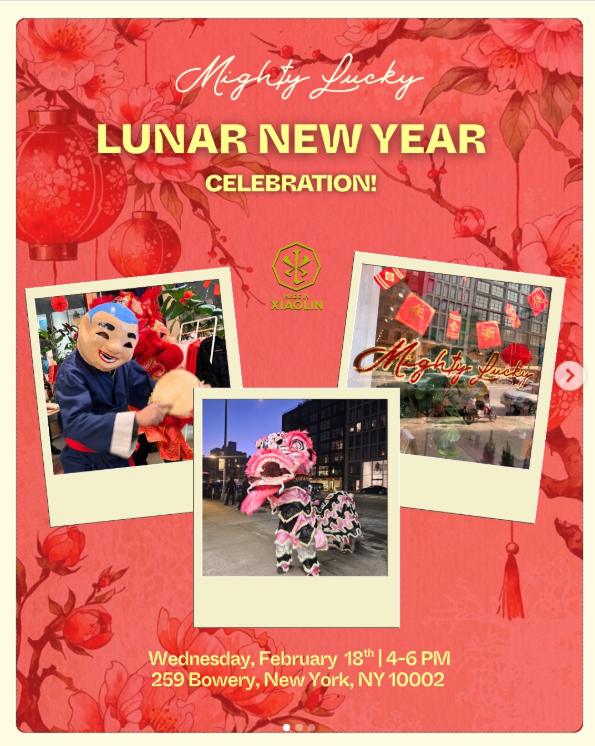
One such brand, Chinese-owned and Soprano’s inspired, Xiaolin (aka Made in Xiaolin)’s CEO, Christopher Louie, is celebrating the Lunar New Year by sponsoring a traditional lion dance at Mighty Lucky on Wednesday, February 17, at 5 p.m. ET.

Tim Li, CEO and co-founder of the nearby Asian-owned dispensary Lighthouse, said he will likely stop by, demonstrating celebratory camaraderie rather than competition.
Li, who grew up in the projects, was busted for cannabis at the tender age of 12 and sent upstate. He was subsequently awarded a NY Conditional Adult-use Retail Dispensary (CAURD) license as a person formerly incarcerated for a non-violent cannabis crime, as was Doo Kim’s husband and partner.
In addition to the dispensary at Lighthouse, the three-floor property at 381 Broadway features an 8,000-square-foot event space currently used to promote wellness, including breathwork, meditation, and tai chi.


Presidential Candidate turned Dispensary Investor
Lighthouse dispensary features former presidential candidate and prolific author Andrew Yang as an investor.
“Lighthouse stands on the intersection of wellness and intentional cannabis consumption in a neighborhood that craves present, grounded spaces,” said Yang exclusively to CTT. “As the Lunar New Year marks a season of renewal and strength, their products, culture, and team are poised to create lasting community impact in TriBeCa and beyond.”
“I’m grateful to be invested,” Yang continued, “and look forward to their continued growth in the years ahead. Happy Lunar New Year!”
Product Promos on Chinese Brand Xiaolin
Incidentally, Lighthouse is offering 10% off Xiaolin products for Lunar New Year, making it the perfect time to pick up a coveted cannagar.
Nearby femme-focused dispensary, Alta on Kenmare, is also celebrating in style.
Cannabis Use in Chinese Culture


According to Psychology Today, some of the earliest archeological evidence of cannabis use, about 10,000 B.C., comes from rope imprints on broken Chinese pottery. Fragments of hemp cloth have also been found in Chinese burial chambers dating from the Chou Dynasty (1122-249 B.C.).
Chinese people are credited with inventing paper. Fragments of paper containing hemp fiber have been found in Chinese graves dating to the first century B.C.
Additionally Early Chinese civilizations used the hemp plant for rope, clothing, bowstrings, and, of course, medicine.
Ancient Anesthetic
Emperor Shen-Nung (c.2700 B.C.) is known as the Father of Chinese Medicine. Because he was concerned about his subjects, he sought plant-based remedies to alleviate their ailments. According to legend, Shen-Nung experimented with poisons and their antidotes on himself and then compiled an herbal medicine encyclopedia called Pen Ts’ao, which includes the cannabis plant, “ma.”
Also read: Is Hemp the Future of Flooring
Ma was a unique treatment because it was both feminine (yin) and masculine (yang). When yin and yang were in balance, the body was in homeostasis.
Recognizing that the female plant yielded more medicine, Chinese cultivators preferred it. Ma was used to treat yin deficiencies, including gout, rheumatism, malaria, constipation, menstruation, and even absentmindedness, according to Marihuana The First Twelve Thousand Years, by Ernest L. Abel.
During the second century A.D., the Chinese surgeon, Hua T’o, combined wine with cannabis for use as an anesthetic.
The first year of the Fire Horse in 50 years is associated with bold action, spontaneity, fearlessness, and breakthroughs, like ma’s use in medicinal remedies.
Cannabis was a multipurpose plant in ancient Chinese civilization. It has been cultivated and used for thousands of years. Given such a lengthy and immersive history of using almost every aspect of the plant, Lunar New Year should also be a time to visit Asian-owned modern apothecaries that celebrate one of history’s most versatile plants.