


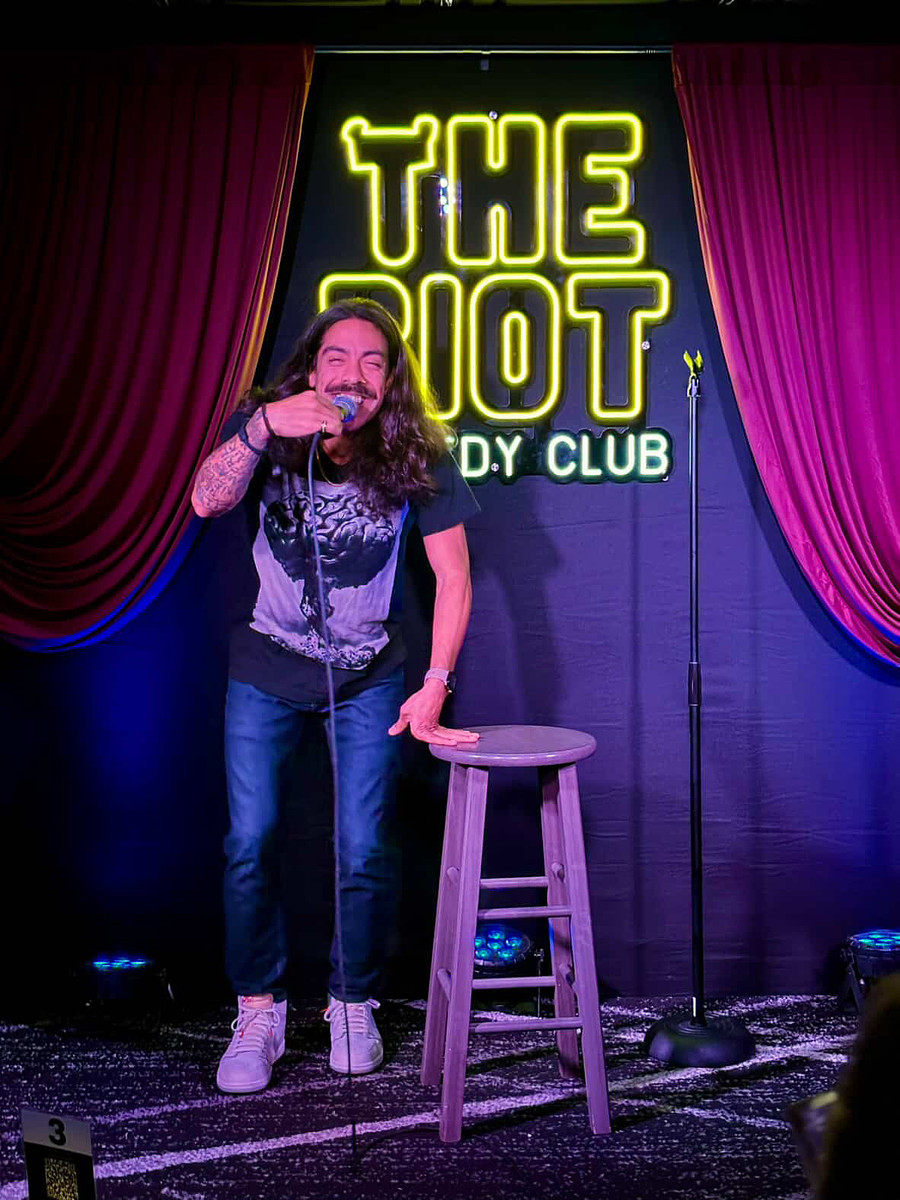
By the time he was 12, Dallas Vann had already endured an exorcism.
By 17, he was drinking every day.
By 35, he had stacked up three DWIs, six wrecked cars, and a month in jail. Now he has two years of sobriety, a rising stand-up career, and a morning ritual that starts with cannabis and coffee, taken like medicine.
He came to cannabis young, in a household he described without flinching.
“One of my first jokes was about my dad, my stepdad, and my brother all going to prison on the same day but for different reasons, and that’s true,” he said. “So that’s the household that I grew up in.”
The Years He Lost
From late adolescence through his early 30s, Vann replaced cannabis with liquor.
“I was so into the drinking that I started cutting out the cannabis and I started not eating, not taking care of my body, not sleeping, dealing with more anger issues, rage issues,” he said. “I’m so angry that I missed that chunk between 17 and 33.”
Alcohol, he explained, was a mask. He was beginning to perform comedy and wanted to appear fearless. He did not want audiences or peers to see his anxiety or his anger at a chaotic childhood. Drinking flattened those emotions in public, while amplifying them in private.
The damage stacked up like empty bottles in the passenger seat. Three DWIs. A second arrest before he’d completed probation for the first would result in jail time.
Incarceration, strangely, became a proving ground. He started making the pods laugh, a genuine commodity in a place where spirits are always running low. Somewhere between count time and commissary, he realized comedy might be a way out of his current situation.
The final turning point came after he wrecked his truck following a day of drinking tied to a podcast appearance. He ran from the scene and woke the next morning without memory of how he had made it home.
“I woke up that next morning and was just like, ‘You didn’t get lucky again. Something is saving you for a reason,’” he said.
He never wanted to drink again after that.

Introspection Over Escape
In lieu of a 12-step program or white-knuckling sobriety, Vann opted to smoke cannabis.
“When I quit drinking and I started smoking, initially it was taking a look at myself,” he said. “It really gave me an introspective view on who I was, who I was hurting, who I was becoming. It’s almost like a form of meditation.”
He rejects the common refrain that cannabis induces anxiety. In his view, the anxiety is not created by the plant but revealed by it.
“It’s showing you right there, hey, these thoughts, whatever you’re avoiding, you have to deal with,” he said.
For someone who had spent 17 years masking emotion, the effect was destabilizing yet transformative. Cannabis, in his account, forced an ego check. It asked questions he had long deferred.
The day-to-day changes were practical. He ate regularly, slept, and most importantly, was present with his child. He began to see sobriety as less about abstinence from every substance, and more as a separation from the one that was killing him.
Read More: LA’s $400 Million Cannabis Tax Gap: Last Week in Weed March 2–9, 2026 – Cannabis & Tech Today
Cannabis And The Craft
Vann’s creative process now runs on a pairing familiar to many writers and performers.
“Cannabis and a cup of coffee,” he said. “People ask me, ‘Hey, how do you write your jokes?’ Cannabis and coffee.”
He bristles at the idea that prescription stimulants are inherently more legitimate than plant medicine. For Dallas, cannabis offers clarity without the aggression he associated with alcohol or the dissociation he experienced with prescription medicine.
Onstage, he smokes before he performs. The result, he said, is a shift in tone.
“As a creative, I feel like cannabis is a good way to help me articulate what I’m trying to say in a non-aggressive way,” he said. “When I smoke, I get more empathetic and I start to see past who did what and what they did, thinking about the bigger picture of it.”
He described both comedy and cannabis as pressure valves. Each allows him to process volatile material without detonating. Alcohol narrowed his perspective and sharpened his edge. Cannabis widened it. It let him approach politics, trauma and personal failure with humor rather than hostility.
“When I smoke and I really sit down and chew on a thought, I am now able to look at it from different angles,” he said.
A Case For Regulation
Vann’s support for federal legalization is rooted in harm reduction and in a friend’s recent health crisis.
One of his closest friends, an avid consumer who works in a smoke shop and tracks cannabis legislation closely, was recently diagnosed with congestive heart failure. Vann connected the diagnosis to a market flooded with unregulated derivatives.
“Legalize it federally, mandate it, tax the ever-loving shit out of it. We’ll still buy it,” he said. “Fix a couple roads. Put the money towards the education system.”
His argument is a pragmatic one. Without federal legalization, states are left with patchwork systems. Consumers encounter Delta-8 and other hemp-derived products that operate in regulatory gray zones. In his view, the absence of clear standards creates avoidable risk.
He is not naive about corporate influence, acknowledging concerns about mass production and quality control. But he sees room for a tiered market that mirrors alcohol, with both large-scale brands and craft cultivators.
The through line is safety. If cannabis is medicine, then it should be grown and sold as such.
Vann speaks with the intensity of someone who has outlived his own statistics. He does not romanticize his past. He is angry about the years he lost, and above all, is grateful for the ones he has.
